Thrive Rural Development Framework
Thriving regions are created through a set of interconnected conditions that allow people and communities to flourish.
SCROLL DOWN
About this Rural Development Framework
To achieve equitable rural prosperity, we need ways of thinking and acting that are powerful enough to move communities to action, build shared purpose across regions, and change the status quo.
The Thrive Rural Framework weaves together current rural innovation and tested approaches for a wide range of issues integral to achieving equitable rural prosperity that is both sustainable and durable.
It’s built on Aspen CSG’s decades of work in regional and rural development, community development philanthropy, and whole family prosperity efforts. The framework is directly informed by rural practitioners and researchers.
We worked with advisory committees, numerous local and regional organizations, national networks, and research partners for several years to formulate the Thrive Rural Framework.
Critically, the Thrive Rural Framework confronts and seeks to address the unique types of rural structural discrimination people in rural communities and Native nations face. Discrimination based on place (size or location of the community), race (racial, immigrant, or cultural identity), and class (wealth or income) vary from place to place, but they affect every aspect of life — from who is included in decision-making groups, to the design of policies and regulations.
The Thrive Rural Framework is designed to help community leaders, practitioners, policymakers, and other rural prosperity champions to take stock, target action, and gauge progress on equitable rural development with these fundamental considerations in mind.
The framework is a living tool, so please share your insights about things that are missing or ways it should change.

What Partners are Saying
We were drawn to the Thrive Rural Framework because public health is integral to each individual’s and every community’s ability to thrive. We are dedicated to building partnerships in communities facing shale gas development in ways that support community strengths and use data to protect public health. The asset-based approach of the Thrive Rural Framework mirrors our own work in engaging hyper-local groups while simultaneously working across local and system levels of change to understand and address the underlying factors that must be true to create prosperous rural communities.
– Jacquelyn Omotalade, Public Policy Manager, Environmental Health Project
How to Use this Framework
We invite everyone invested in the prosperity and wellbeing of rural communities and regions — from local leaders to investors and philanthropists to state and national policymakers — to use the framework as the starting point of a shared approach.
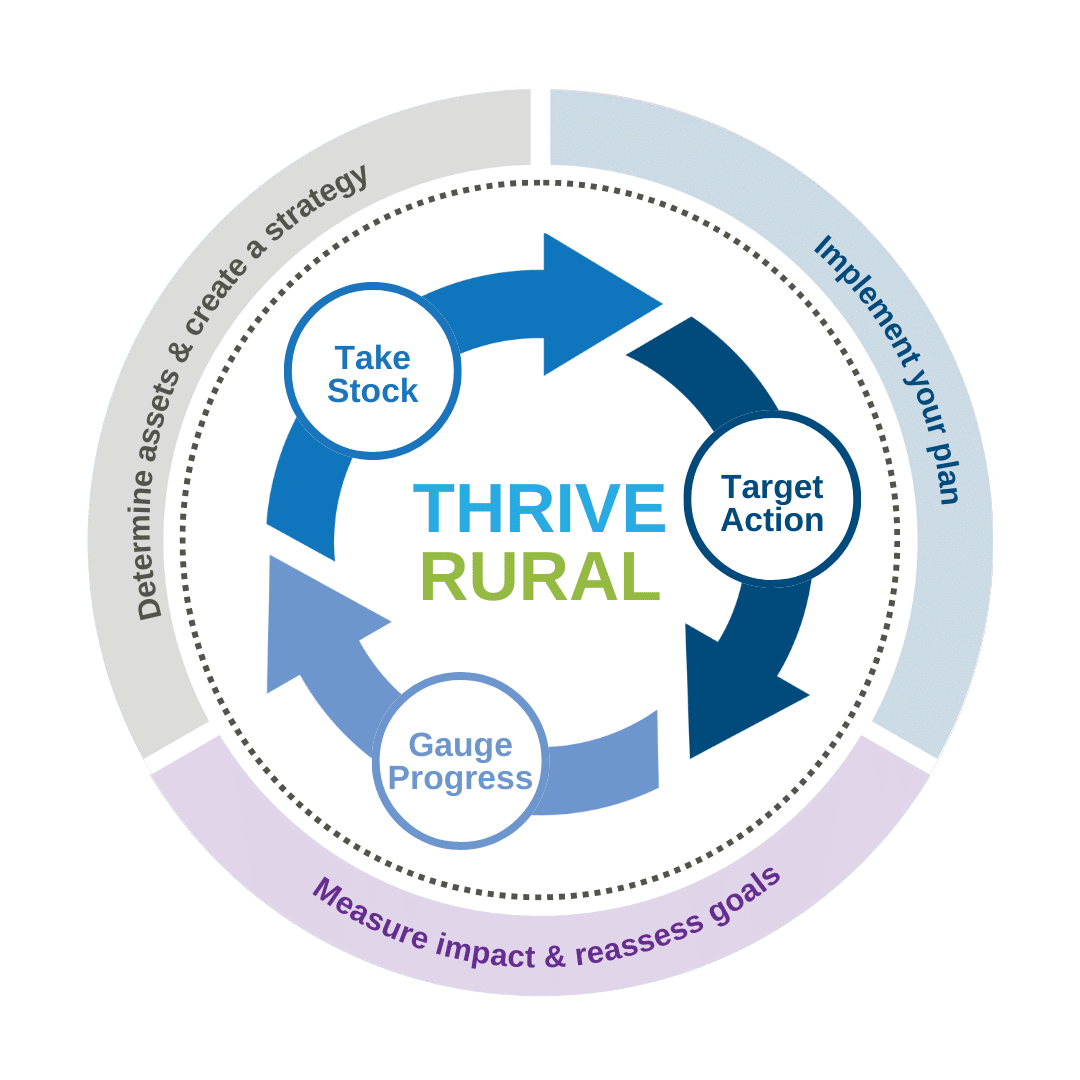
You can start at any stage in this cycle and build on the rural development work you are already doing. Consider your work and what action might be next based on where you are right now.
Take stock: Determine your assets and which building blocks you must focus to advance rural prosperity for all in your region, role, or system. Use this information to create a strategy and determine measurements of success.
Target action: Implement initiatives and programs that strengthen building blocks to broaden and deepen rural prosperity.
Gauge progress: Measure your impact and reassess your goals to find new points of action within rural economic and community development.

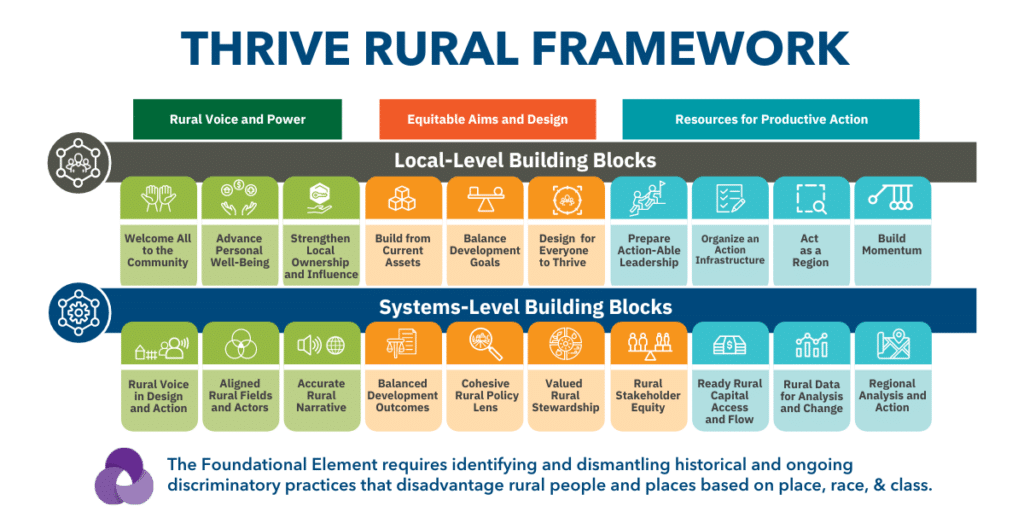
Thrive Rural Framework

The Foundational Element
The Foundational Element of the framework requires identifying and dismantling historical and ongoing discriminatory practices that disadvantage rural people and places. Much historical and existing rural structural discrimination is based on:
Place
location or size of community
Race
racial, immigrant, or cultural identity
Class
wealth or income level

Local-Level Building Blocks
Local-Level Building Blocks focus on conditions on the ground in rural places that individual communities or regions can work on by themselves.

Systems-Level Building Blocks
Systems-Level Building Blocks are elements that must be true for equitable rural development but are outside the local community’s direct control.
Welcome All to the Community
Each person in the community is welcomed, feels connected, and is able to exercise and influence power in decision-making.
Advance Personal Well-Being
Each person in the community has the skills, resources, and social supports they need to pursue and live a healthy, safe, and fulfilling life.
Strengthen Local Ownership and Influence
Businesses, institutions, organizations, and resources critical to the community and its future are owned locally and/or directed and advised by the full range of community members who have a stake in their durability and success.
Rural Voice in Design and Action
A robust, representative, diverse and powerful network of Native nation and rural leaders, practitioners, and doers consistently engage in advising and influencing narrative, policy design, and action agendas across sectors and levels of government.
Aligned Rural Fields and Actors
Rural community, economic, health, social, and professional development field intermediaries, practitioners, and influentials all share the definition of equitable development success and align their strategies to achieve those outcomes.
Accurate Rural Narrative
Public media and dialogue consistently relate an accurate understanding of the history, conditions, lived experience, and economic, demographic, cultural, and geographic diversity of rural communities and Native nations.
Build from Current Assets
Local rural economic development approaches concentrate first on identifying and building on the area’s existing people, place, business, and organizational assets to increase both well-being and equity outcomes.
Balance Development Goals
Local actions that concurrently strengthen a community’s infrastructure, economy, and natural environment to advance the sustainability and durability of all three.
Design for Everyone to Thrive
Local leaders intentionally design rural community development and economic development efforts to improve outcomes for people disadvantaged due to historic or ongoing economic, racial, age, gender, or cultural discrimination.
Balanced Development Outcomes
Policymakers and investors in rural and Native people, places, and enterprises define and measure development success as decreasing economic and racial inequality and reducing poverty while building local wealth, sustainability, and resilience.
Cohesive Rural Policy Lens
Federal and state governments cohesively develop, tailor, and align the design, implementation, regulations, and incentives in policy and laws to ensure rural access and provide a predictable stream of public resources that can be used flexibly, as locally determined, for rural benefit.
Valued Rural Stewardship
Public and private purchasers, users, and beneficiaries fairly compensate rural actors for the natural resource and ecosystem value that rural people, businesses, and organizations produce to sustain natural resources and, thus, America’s future prosperity.
Rural Stakeholder Equity
Governments, businesses, and institutions operated by individuals and owners outside rural communities establish balanced relationships that produce mutual and fair value for the rural community, Native nation, business, and worker stakeholders.
Prepare Action-Able Leadership
Communities have and prepare leaders with the will, skills, relationships, diversity, knowledge, and power needed to fully engage the community and the region to establish, align, and achieve priorities that increase both well-being and equity outcomes.
Organize an Action Infrastructure
Communities have the local and regional institutions, policies, systems, data, information, media, and resources needed to establish, align, and achieve priorities that increase both well-being and equity.
Act as a Region
Communities persistently analyze, develop strategies and act together within and across sensible and workable regions to address shared issues, challenges, and opportunities and achieve outcomes at a productive scale.
Build Momentum
Communities and regions, no matter their starting points, produce and celebrate the small wins and steady progress that fuel hope and persistence.
Ready Rural Capital Access and Flow
Public, private, and philanthropic financial capital and durable funding streams are reliably available, easily accessible and affordable, and consistently and strategically invested in rural people, places, organizations, and economies.
Rural Data for Analysis and Change
Federal and state governments collect and provide a wide range of readily available critical data on rural place, economy and population conditions, and outcomes at the sub-county level – down to census tracts.
Regional Analysis and Action
Public and private policy, investment, and incentives encourage and stimulate collaborative regional action and the capacity of regional efforts to address shared cross-community economic, social, and health challenges and opportunities.
The Ultimate Outcome
Communities and Native nations across the rural United States are healthy places where each and every person belongs, lives with dignity, and thrives.
Frequently Asked Questions
Understanding Rural Development
Rural development is the process of improving the economic, social, environmental, and civic well-being of rural communities and Native nations through community-led, place-based development. It strengthens local economies, healthy communities, leadership, and the relationships that help places thrive over the long term.
Rural development strengthens local economies, improves health and well-being, expands opportunity, and builds resilience by investing in people, relationships, and community assets. Because rural communities and Native nations are essential to the country’s economy, environment, food systems, and cultural heritage, thriving rural places benefit everyone.
Rural residents, Tribal citizens, businesses, nonprofits, local governments, funders, and policymakers all benefit from effective rural development. Strong rural communities and Native nations also support broader regional and national prosperity through food systems, energy, manufacturing, natural resources, recreation, and local economies.
Unlike approaches that emphasize extracting value from rural places without building lasting local capacity, the Thrive Rural Framework focuses on community-led development that strengthens local assets, leadership, and regional collaboration over time.
Equitable rural prosperity means everyone has the opportunity to thrive regardless of race, place, or class. It recognizes that lasting prosperity depends on expanding opportunity while strengthening community assets and systems.
Asset-based rural development starts with a community’s strengths, including its people, culture, natural resources, institutions, and relationships. The Thrive Rural Framework helps communities build on these assets while addressing challenges.
Understanding the Thrive Rural Framework
A rural development framework helps communities assess current conditions, identify strengths, set priorities, and coordinate action across sectors. The Thrive Rural Framework is designed to help users take stock, target action, and gauge progress toward equitable rural development. Explore the Thrive Rural Framework by using the Assessment Worksheet.
The Thrive Rural Framework is designed for community leaders, nonprofits, Tribal governments, regional organizations, philanthropy, policymakers, researchers, and anyone working to strengthen rural communities and Native nations.
Unlike issue-specific frameworks, the Thrive Rural Framework looks across the social, economic, environmental, and civic conditions that support long-term prosperity. It emphasizes community assets, local leadership, and systems change rather than isolated projects.
The Thrive Rural Framework includes local-level and systems-level building blocks that support equitable rural prosperity. Local-level building blocks focus on conditions communities and regions can strengthen directly, while systems-level building blocks focus on broader policy, investment, data, narrative, and institutional conditions that shape rural development.
Yes. The Framework was developed through research, field experience, and collaboration with rural practitioners, funders, and community leaders across the United States. It continues to evolve through practice and learning.
The University of Wisconsin Population Health Institute was a valued collaborator and research partner on the underlying research of the Thrive Rural Framework.
Yes. The Thrive Rural Framework is designed to be adapted to local contexts, including Native nations. It recognizes Tribal sovereignty, self-determination, and Indigenous ways of knowing while helping communities identify priorities, build on local assets, and strengthen the conditions for equitable, long-term prosperity.
Connecting to Action
There is no perfect time to start. Whether your community is launching a new initiative, refining an existing strategy, or simply exploring what’s possible, the Thrive Rural Framework can help. It is designed to help communities ask better questions, identify strengths and opportunities, and guide action at any stage of the work.
The Thrive Rural Framework and the Rural Development Hubs model are complementary tools for advancing equitable rural prosperity. The Framework identifies what conditions communities and regions need to thrive, while the Hubs model describes how regional organizations can build partnerships, align resources, and coordinate action to strengthen those conditions. Together, they provide a shared approach for planning, implementing, and sustaining community-led rural development.
A Rural Development Hub is a regional organization or partnership that connects people, resources, and investments across communities. Hubs help turn the Thrive Rural Framework into action by coordinating partners, building capacity, and supporting long-term regional development.
The University of Wisconsin Population Health Institute was a valued collaborator and research partner on the underlying research of the Thrive Rural Framework.
Learn more about federal rural development resources at the United States Department of Agriculture’s Rural Development webpage.