View this Publication

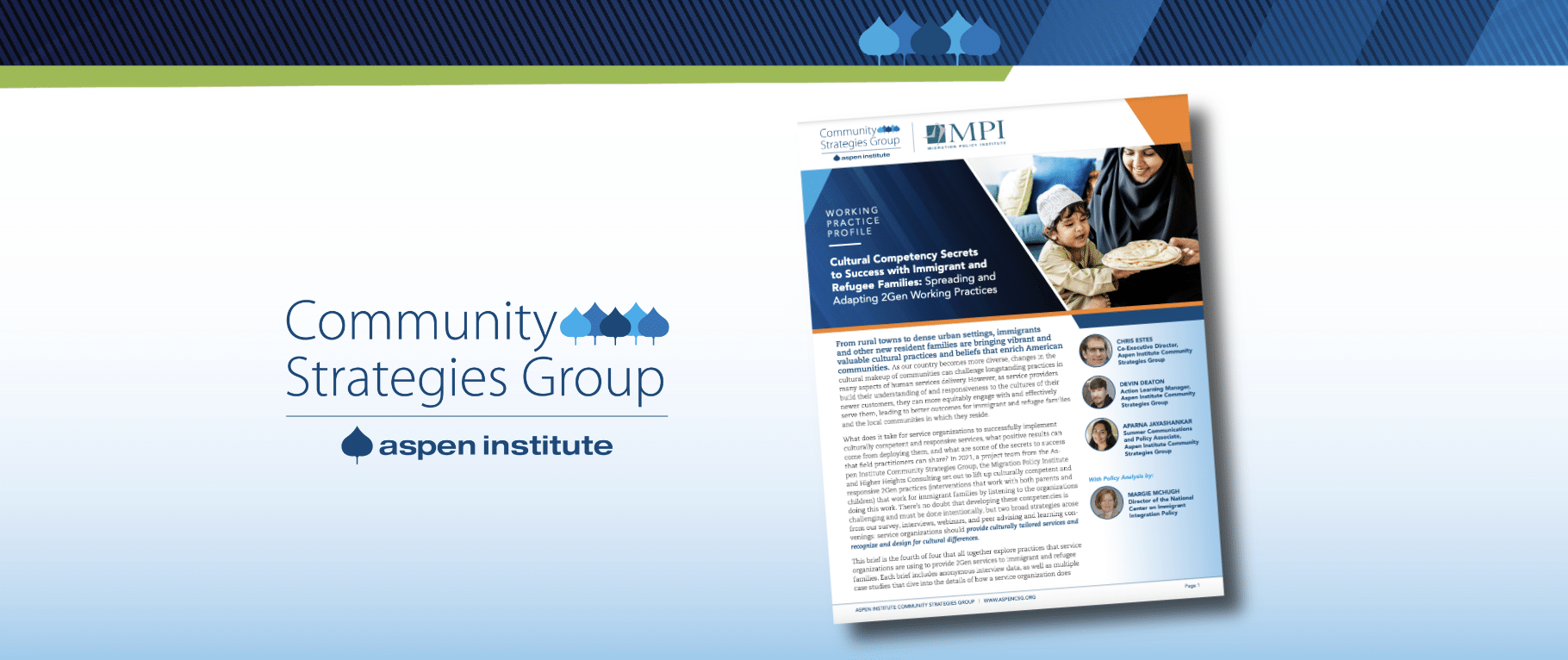
The cultural shift for immigrant and refugee families can be welcomed for some and terrifying for others, but what are the cultural competency secrets to success that can best support these groups? As service providers build their understanding of and responsiveness to the cultures of their newer customers, they can more equitably engage with and effectively serve them, which leads to better outcomes for immigrant and refugee families and the local communities.
Our Family Economic Success briefs capture lessons learned from a year-long project, including four webinars and peer learning sessions, on the best organizational strategies for providing 2Gen services to immigrant and refugee families.
Cultural Competency Secrets to Success with Immigrant and Refugee Families focuses on how organizations can make their work more culturally responsive and effective. This is just one brief within a series; other topics include building trust, growing language skills, and responding to differing immigration statuses.
What is the 2Gen approach?
By working with families to solve problems, access new resources, and sharpen existing talents and skills, the 2Gen approach creates experiences and opportunities for all families to reach their full potential and for communities to thrive economically and socially.
How organizations can serve immigrant and refugee families to ensure that their programs and services are culturally competent:
- Understand and follow cultural norms as much as possible to avoid disrespecting or turning away families. This may involve communicating primarily through a specific person in the family, scheduling events around important festivals, providing meals that meet dietary restrictions, or providing a prayer room.
- Tailor services to address cultural stigmas. Develop wraparound services that address cultural stigmas that may limit family participation in important programs. For example, tailor programs so they recognize and attempt to bridge barriers to discussing and accessing mental health services. That means employment, communicating better with teachers, or a different need. These needs will change with time, so the program should be flexible.
- Design responsive programs that incorporate cultural differences and family experiences. Begin with a needs assessment to understand people’s backgrounds so services can be responsive to family culture and prior experiences they may have had (e.g., trauma).
- Recognize that even families with similar backgrounds may have different cultures. Families may be from the same origin country, speak a similar language, practice the same religion, etc., but still have different cultural values — staff should refrain from making assumptions about a family’s culture.
- Be cognizant of cultural dynamics when hiring staff who are representative of the community. The staff needs to reflect the population they serve; cultural norms and family dynamics should be one factor among the many considered during the hiring process.
- Diffuse tensions between cultures by promoting dialogue between leaders of the different communities. Although there may sometimes be tension between two cultural groups, bringing cultural leaders together and hiring staff from each community helps promote peacemaking.
Event Recording
Organizations that provide culturally tailored services and design for cultural differences share:
- How nonprofits can understand and adapt their efforts to respond to the cultural context of their target population;
- How staff working with immigrant and refugee families can recognize and design for cultural differences;
- How service organizations can respect cultural norms while developing wraparound services that address cultural stigmas.

Featured Experts
Rawaa Nancy Albilal: President & Chief Executive Officer, Arab-American Family Support Center (AAFSC)
Danny Salim: Senior Director of Solution Based Casework – Brooklyn, Arab-American Family Support Center (AAFSC)
John Till: Senior Vice President of Strategy and Innovation, The Family Partnership
Karen Murrell: President, Higher Heights Consulting
Chris Estes: Co-Executive Director, Aspen Institute Community Strategies Group
Devin Deaton: Action Learning Manager, Aspen Institute Community Strategies Group
Aparna Jayashankar: Communications and Policy Associate, Aspen Institute Community Strategies Group
Margie McHugh: Director of the National Center on Immigrant Integration Policy, Migration Policy Institute