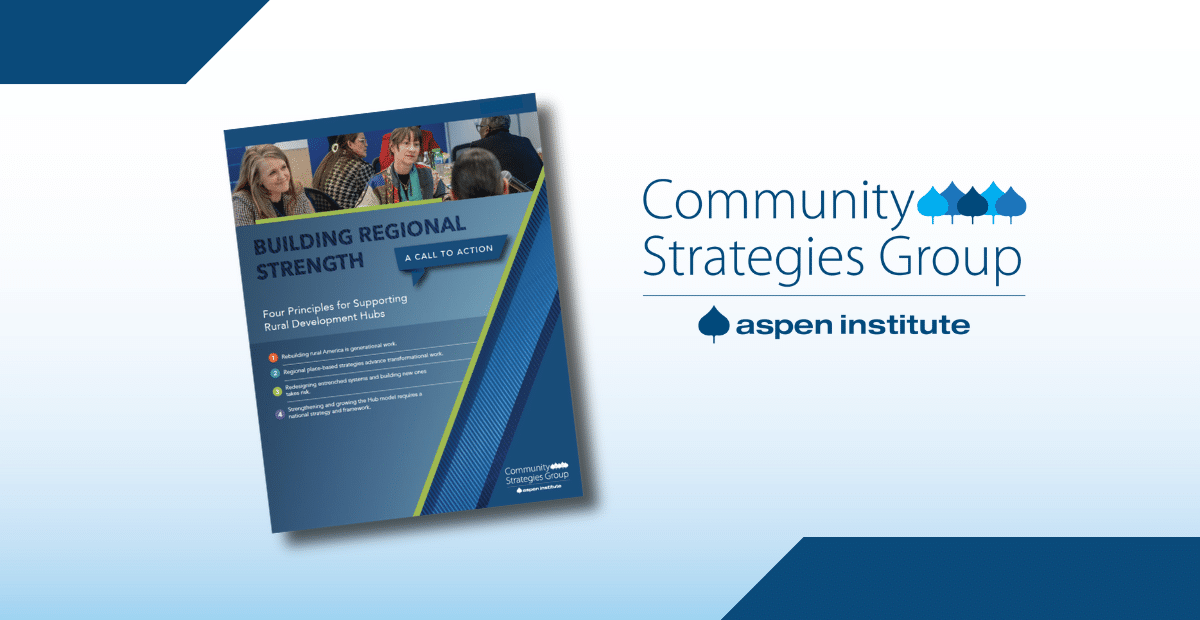
View this Publication

Welcome — use the sidebar to navigate to different report sections. Or get quick recommendations for government, philanthropy, and practitioners. And don’t miss the related resources at the bottom of this page!
Introduction
Rural communities are dynamic, diverse places with assets that can drive regional prosperity. Yet they have long faced a shortage of reliable investment to build sustained regional capacity. In the absence of consistent national policy and funding, rural regions must collaborate across geographies, sectors, and issue areas to seize opportunities and address challenges.
Building on more than 40 years of work with rural development leaders, the Aspen Institute Community Strategies Group (Aspen CSG) defined Rural Development Hub in 2019 as a critical organization that leads and facilitates community-driven regional transformation.
Hubs are not defined by their organization type—they can be community foundations, CDFIs, nonprofits, and more—but by how they work:
- Hubs are rooted in their region—showing up for their communities every day.
- Hubs respond to local needs rather than ideology, partisanship, or rigid external frameworks.
- Hubs are lean, efficient, creative, and flexible, leveraging minimal resources through connection, risk-taking, and coordination.
- Hubs hold a broad perspective that links place-based work with regional and national efforts.
Rural America urgently needs more organizations implementing the Hubs model to serve as essential regional infrastructure for transformative development.
Meeting the Moment: Hubs’ flexibility and adaptive approach make them well-suited to help communities navigate change and challenge. When resources are scarce, they strengthen collaboration and build capacity so regions can do more with less. When circumstances shift quickly, they draw on relationships and connections to bring people and organizations together to meet the moment.
How to Support Hubs
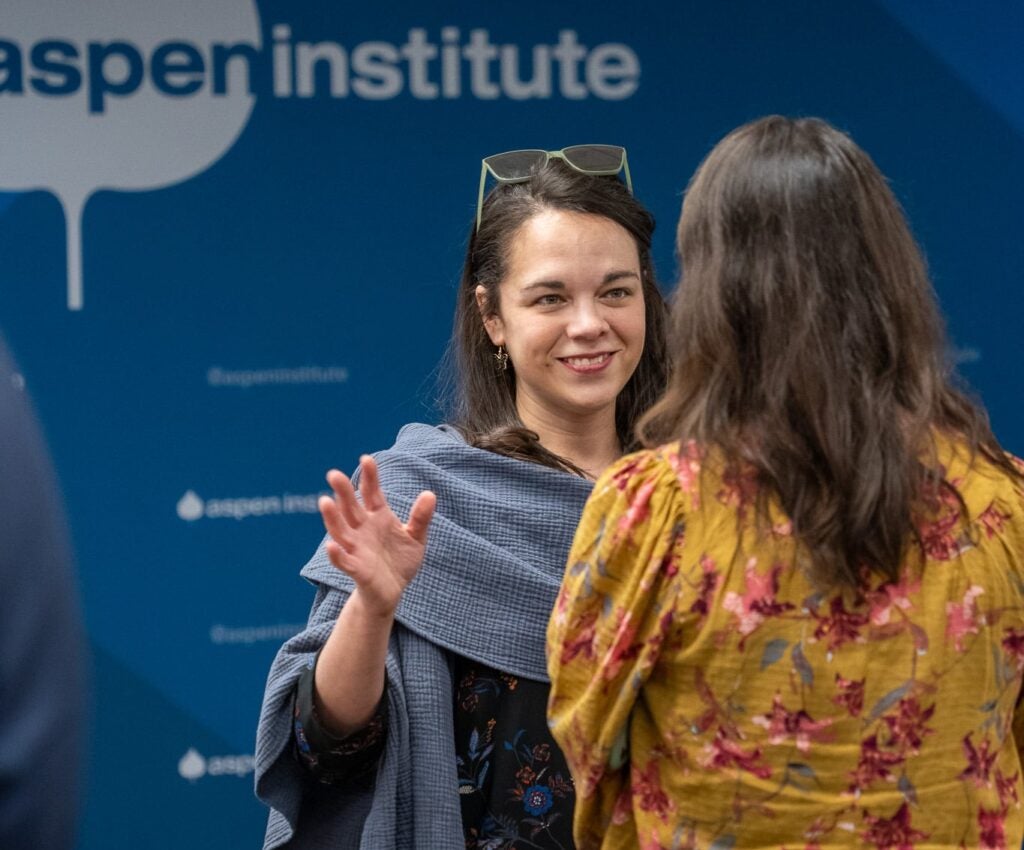
Given their unique position and potential for impact in rural regions across the country, Rural Development Hubs need stronger and better-aligned support to do their essential work.
Funding support: Hubs are efficient and versatile, making them a strong investment for funders seeking to maximize impact with limited resources. However, to function effectively, Hubs need flexible funding that allows them to respond to changing community needs, rather than fulfilling a complicated web of fixed projects. Project-based financing, by contrast, creates fragmented systems that drain staff capacity and prevent Hubs from doing what they do best—responding to their communities.
Collaborative support: Hubs are built to partner. To succeed, they need open and committed collaboration from government, philanthropy, and private organizations that understand the Hub model. A scarcity mindset can undermine this, as partners compete for power and territory. Effective partners learn how Hubs work, understand their own roles in the ecosystem, and look for ways to strengthen connection and collaboration. (See: Rural Development Hubs: Strengthening America’s Rural Innovation Infrastructure and The Power Of Connection: Rural Development Hubs In Action)
Technical support: Hubs take on multiple roles, which necessitate access to training, resources, and direct assistance with the technical aspects of their work. Current technical support is often fragmented, prescriptive, or designed for urban contexts. Tailored, accessible support aligned with the Hub model would accelerate their impact in rural regions.
Transformational Rural Development: Aspen CSG uses the term “transformational rural development” to describe strategies grounded in community strengths and assets, holistic in approach, and driven by community voices and needs (e.g., WealthWorks). The goal is to create regions where each and every person belongs, lives with dignity, and thrives (see Aspen CSG’s Thrive Rural Framework). Transformational rural development differs from transactional approaches by emphasizing ongoing programs and systems change rather than one-off projects. It can complement traditional strategies such as business attraction and retention. While the term “transformational” can imply significant or dramatic changes, this type of development can drive change at any scale, depending on community priorities.

“Part of the beauty of Rural Hubs is that we create muscle memory for what’s right for that place.“
Tiffany Sanderson, Lake Area Technical College, South Dakota

“We’re just going to keep showing up, whether it’s good, bad, hard, whatever. That’s the commitment— we are going to keep showing up.”
Stephanie Tyree, West Virginia Community Development Hub, West Virginia

“When [Hubs] have to create a new program to get money, it creates a daisy chain of subsidizing the other three programs you created to get money. And you end up just shuffling stuff around. That’s why unrestricted funding is so valuable.”
Tito Llantada, Trust for Civic Life, Colorado
“If Hubs don’t have resources, they can’t deliver for anyone else. They need real investment — funding, training, peer learning, and technical support — to do this work well.”
Jennie Stephens, Center for Heirs Property Preservation, South Carolina
Creating this Report
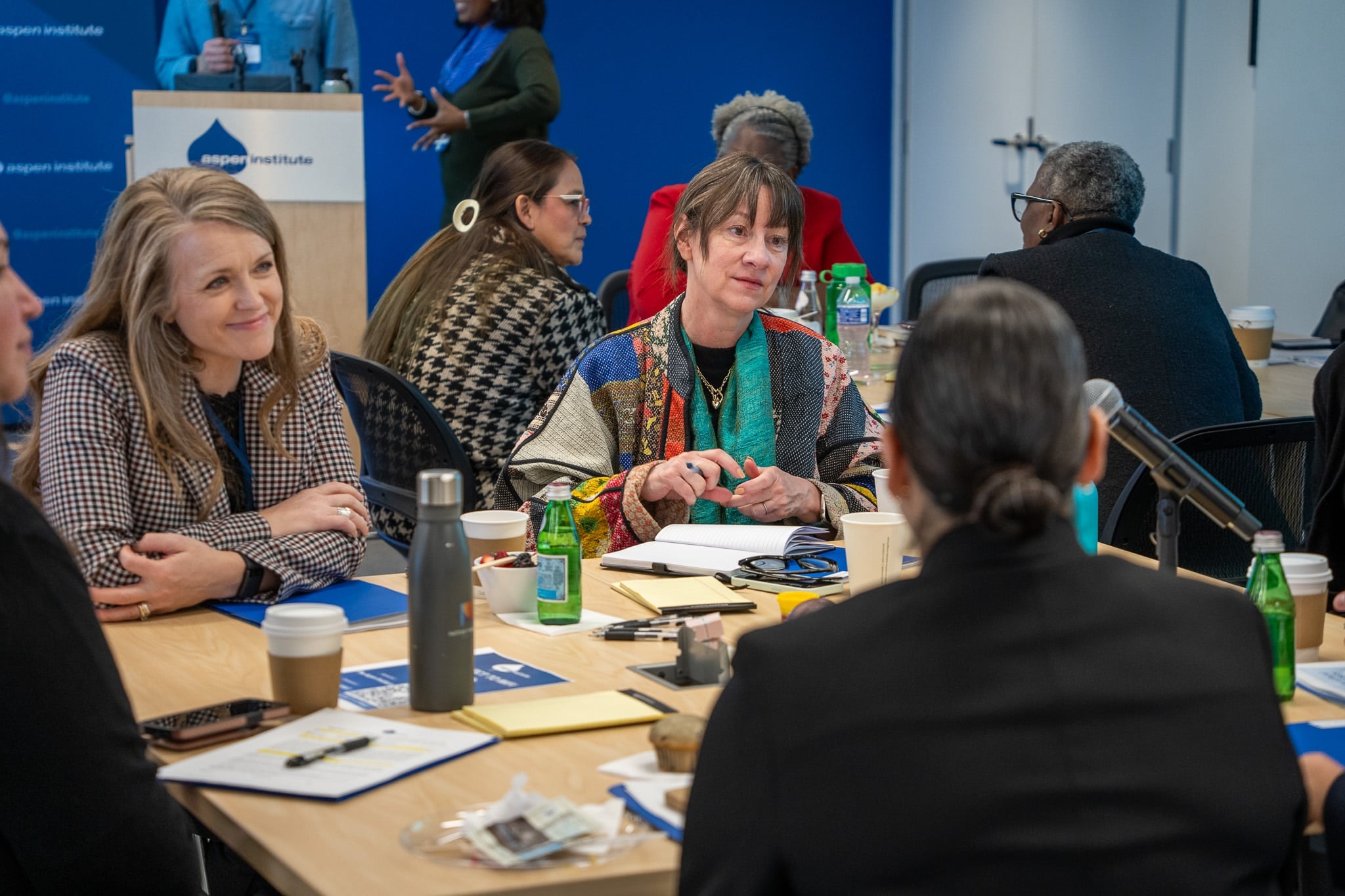
In March 2025, Aspen CSG staff met with Rural Development Hub leaders to explore what’s needed to strengthen and expand support for Hubs. This report shares what we learned and offers recommendations for decision-makers to better support Hubs—both as individual organizations and as a national network.
The group’s collective expertise spans a wide array of fields, including rural community economic development, housing, transportation, small business development, family asset building, development finance, grassroots community engagement and advocacy, and regional development. Together, they represent deep experience and leadership, serving as highly respected and dedicated changemakers in their communities. A detailed list of TRALE participants is provided at the end of this webpage.

Principle 1: Rebuilding rural America is generational work.

The long history of disinvestment, extractive economies, and other economic challenges facing rural and Indigenous communities necessitates that Rural Development Hubs adopt a long-term perspective. Addressing these challenges requires sustained commitment from government and philanthropic partners to match Hubs’ commitment to their regions.
Rural development has never had adequate, consistent support to build capacity on the ground. Today, only 3-6 percent of philanthropic funding reaches rural communities, and just .05 goes to Native nations and Indigenous communities. Raising that share to 10 percent—about $20 billion more each year—would still fall short of parity with urban and suburban philanthropy, but would be transformative.
The structure of investments matters as much as the amount. Funding from federal and state governments is often fragmented and rigid, hampering Hubs’ ability to work holistically and build capacity (see Funding Rural Futures: A Call to Action). Investments tailored to the Hub model would operate on longer time scales, adjust to changing circumstances, and strengthen community capacity alongside specific projects.
Because Hubs’ work is generational, it also requires investment in leadership. Traditional approaches often focus on external deficits or narrow definitions of what a “leader” looks like. By contrast, successful strategies recognize that leaders emerge from varied backgrounds and that rural regions already possess the talent and vision necessary to transform their futures.
Rebuilding rural America will be faster and more effective if investments are sustained, holistic, flexible, and capacity-building rather than short-term or transactional.
Case Study: Sustainable Forestry and African-American Land Retention Network
SFLR is undertaking generational capacity-building work from the ground up in their communities.
Thrive Rural Framework building blocks:
Local: Prepare Action-Able Leadership
Systems: Ready Rural Capital Access and Flow

“We frequently overestimate what we can get done in a year, and we often underestimate what we can get done in a decade. It’s essential to have that longer time horizon and be willing to build those relationships and that trust.”
Jeff Yost, Nebraska Community Foundation, Nebraska
“If we could leverage sufficient philanthropic or government resources, we could move sectors and places from stuck to market performing—not an ongoing infusion, but investment that supports a transition to functioning economies in our communities.”
Peter Hille, Mountain Association, Kentucky

“Some of us have been doing rural development for a long time. Before we all retire to sit and read books, how do we share our insights and experience with the next generation of leaders?”
Heidi Khokhar, Rural Development Initiatives, Oregon
Principle 2: Regional place-based strategies advance transformational work.

Rural and Indigenous communities are part of regions that cross geographic and political boundaries. Yet many development efforts focus on a single town or county for reasons of jurisdiction or political representation. Without collaboration across municipalities, counties, Tribal governments, and community organizations, these efforts often have limited impact. A regional lens is essential for addressing shared challenges, leveraging all available assets, and advancing transformational work.
At the same time, rural development efforts often focus on a single sector such as healthcare, education, or a specific industry. Outside organizations or actors may sometimes lead these siloed projects with a limited understanding of local people and place, or of the efforts happening in other sectors. At best, they miss opportunities for collaboration; at worst, they compete with or divert resources from more locally driven efforts.
Rural Development Hubs connect local leaders and projects across regions to amplify the impact of all investments. Supporting Hubs requires adopting a regional, place-based lens that maximizes assets and coordinates action across levels—from local practitioners to national policymakers and funders. This means shifting from top-down, fragmented, sector-specific investments toward holistic efforts that are regionally designed and led.
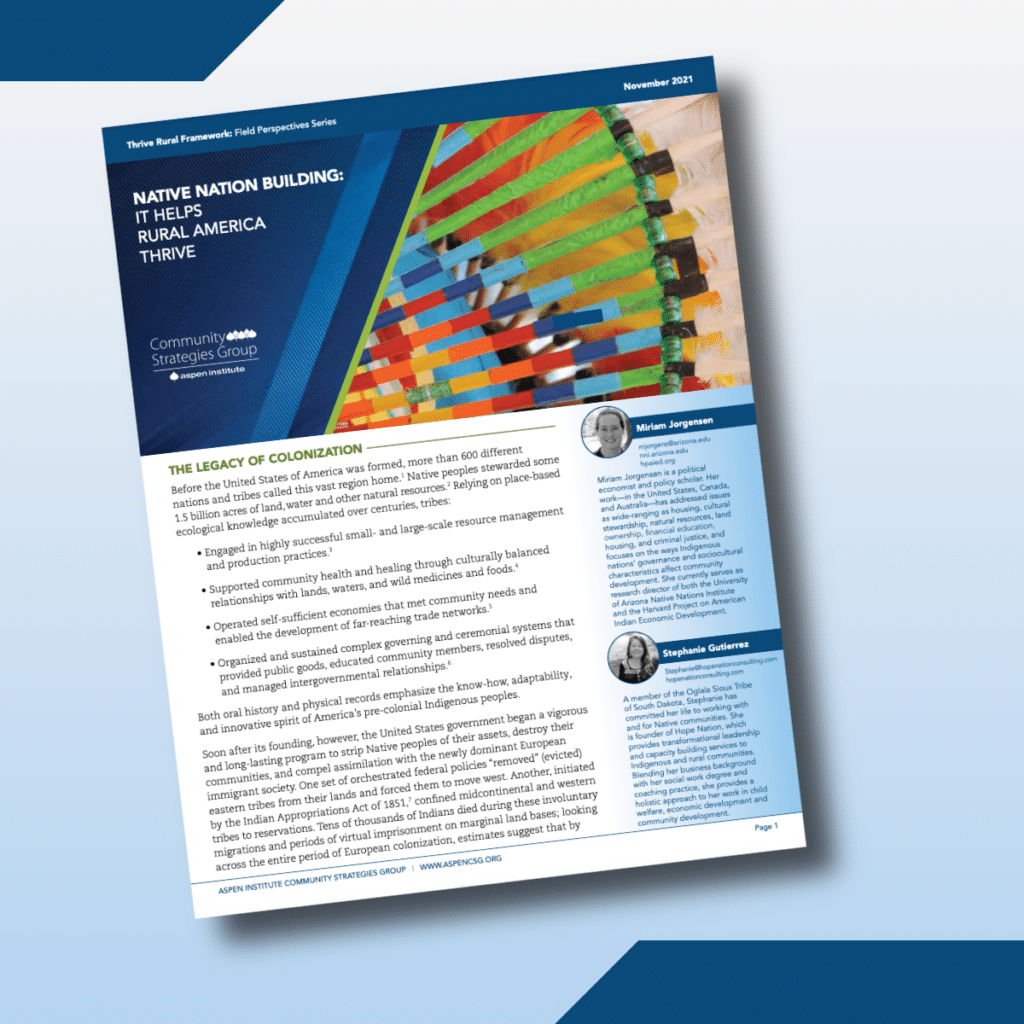
Case Study: Native nation building—it helps rural America thrive
When Native nations are connected, respected, and acting in concert with other entities, the entire region can thrive.
Thrive Rural Framework building blocks:
Local: Act as a Region
Systems: Regional Analysis and Action

“If everyone saw the benefit of regionalism in rural, then we could move more swiftly and have more impact.”
Winter Kinne, Community Foundation of the Ozarks, Missouri

“Sometimes I wonder—can we just be ourselves —and trust that who we are is enough to uncover the genius and solutions our communities need? As one elder reminded us, ‘We need to remember who we are.’ Not just as an idea, but as an act of re-membering—of bringing our broken pieces back together and becoming whole again.”
Janice Ikeda, Vibrant Hawai’i, Hawai’i
“It happens all the time—outside people with solutions coming to tell Tribal communities “this is what you need to do to be successful, this is our interpretation of what you need” versus community-led solutions. ”
Alissa Benoist, Four Bands Community Fund, South Dakota
“I always come back to the fact that the only people who can build and sustain a community are the people who live and work in it.”
Jeff Yost, Nebraska Community Foundation, Nebraska

I don’t think someone could just show up and say, “Well, I just want to be a Hub today and now I’m going to do all these things,” because the trust building takes a long time. — Winter Kinne, Community Foundation of the Ozarks, Missouri
I know, it’s about that connection back to community, right? There has to be an organic connection. Because if someone comes in and tells you what to do, it doesn’t work, not at all.— Alissa Benoist, Four Bands Community Fund, South Dakota
Principle 3: Redesigning entrenched systems and building new ones takes risk.

Many systems that shape rural community and economic development—from funding to measurement—do not function as intended. Some have accumulated layers of changes that create dysfunction; most were never designed for lower-population areas (but simply thought of rural as “smaller urban”); and in some cases, rural and Indigenous communities lack essential systems altogether.
It is challenging to achieve impact within systems that are broken or incentivize actions that are counter to the stated community goals. Yet entrenched systems are hard to change, particularly when reforms challenge established power. Redesigning or creating systems requires courage, commitment, and a willingness to take risks and prioritize what works.
Rural Development Hubs take on this role by analyzing systems and holding risk as part of their core work. This work is vital for the future of rural America, but it is rarely funded. Supporters must find ways to enable it.
Case Study: Building funder capacity to work with communities
Roque Barros of Imperial Valley Wellness Foundation in Southern California is building new systems for funding in rural communities.
Thrive Rural Framework building blocks:
Local: Design for Everyone to Thrive
Systems: Rural Voice in Design and Action
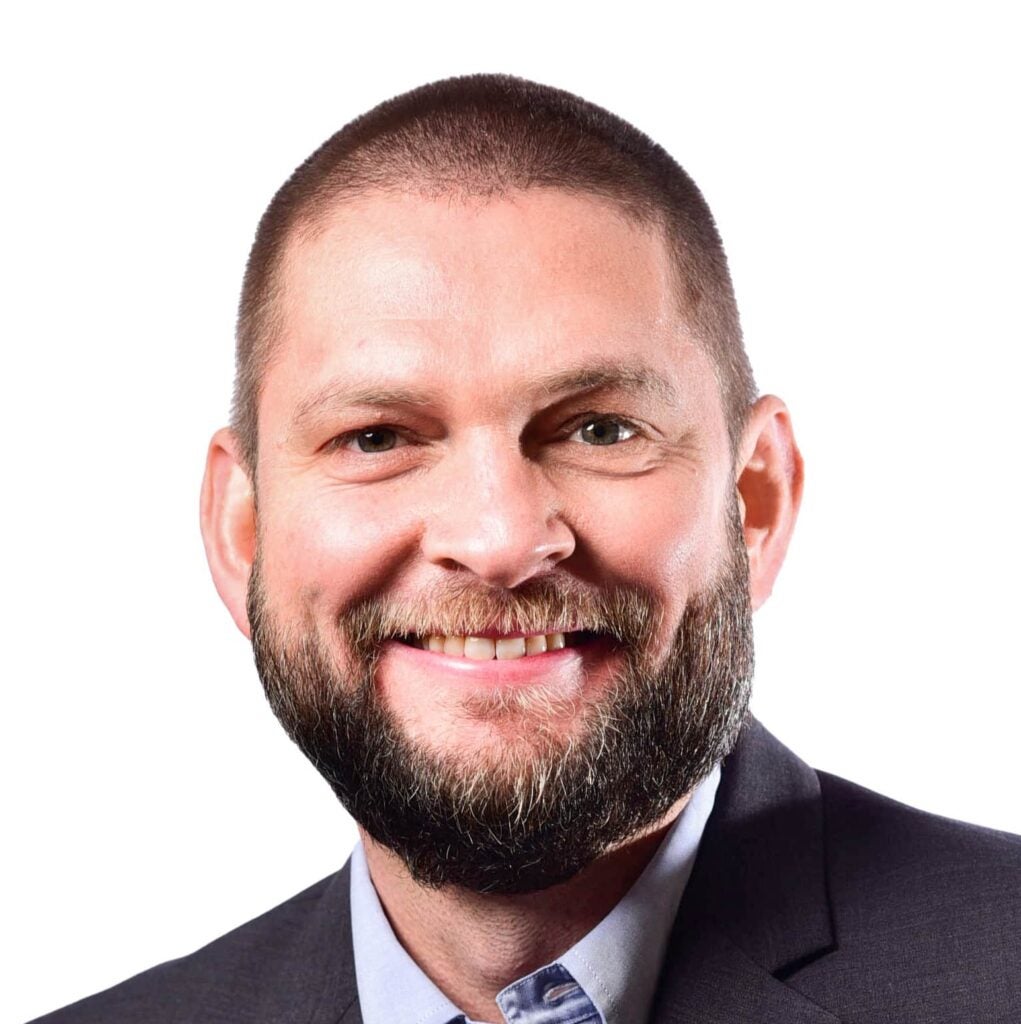
“Hubs have to be like Swiss army knives to some extent—we’re not trying to be scalpels. And I feel like that’s unique to the rural space, because we have to fill whatever gaps exist. In a busy urban or metro nonprofit space, there is often specialization that happens. ”
Jerry Kenney, T.L.L. Temple Foundation, Texas
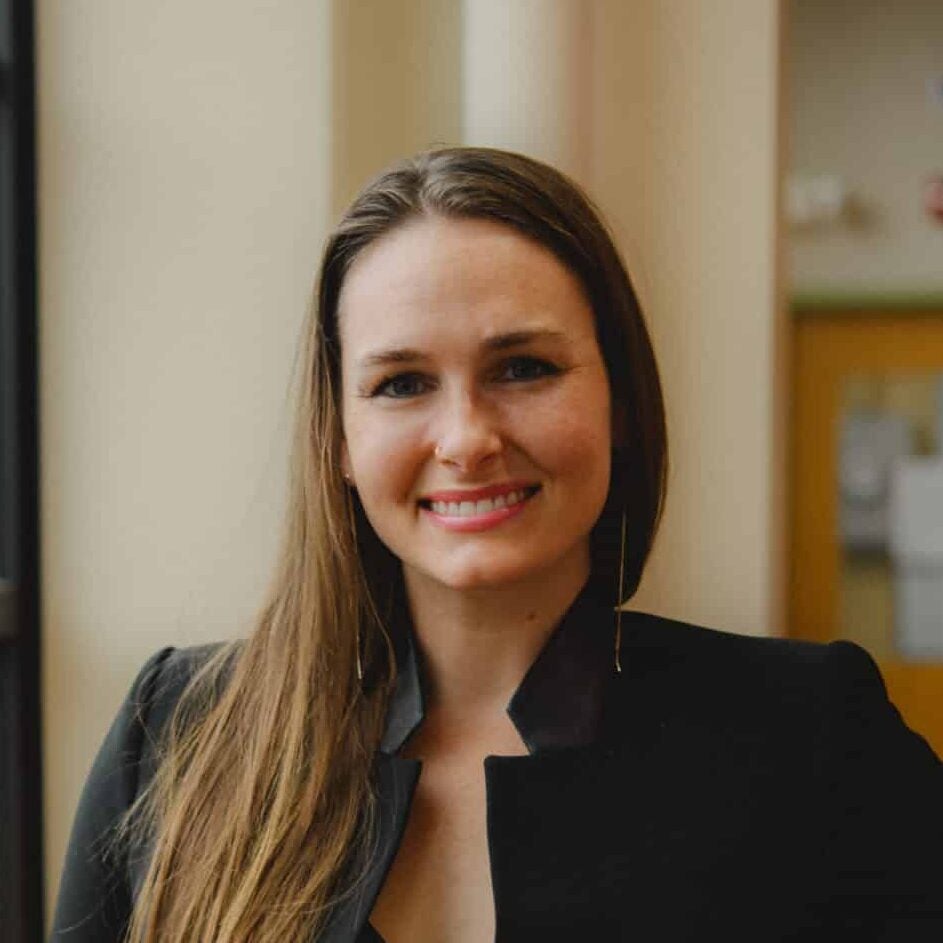
“You do—and you are—what you measure. If we are measuring what actually matters in the long term, then we’re going to figure out how to change our systems to get to these measurements.”
Julianna Dodson, Hannah Grimes Center, New Hampshire

“We lose a little bit of ourselves trying to fit into a certain box that isn’t actually made for our communities.”
Leona Antoine, NACDC Financial Services, Inc., Montana
Principle 4: Strengthening and growing the Hub model requires a national strategy and framework
Rural Development Hubs are leading transformative work across the country—taking the long view, redesigning systems, and uniting regions around place-based strategies. A national strategy and framework are necessary to support existing Hubs, refine, document, and promote the model, and provide resources for regions to establish and grow Hubs.
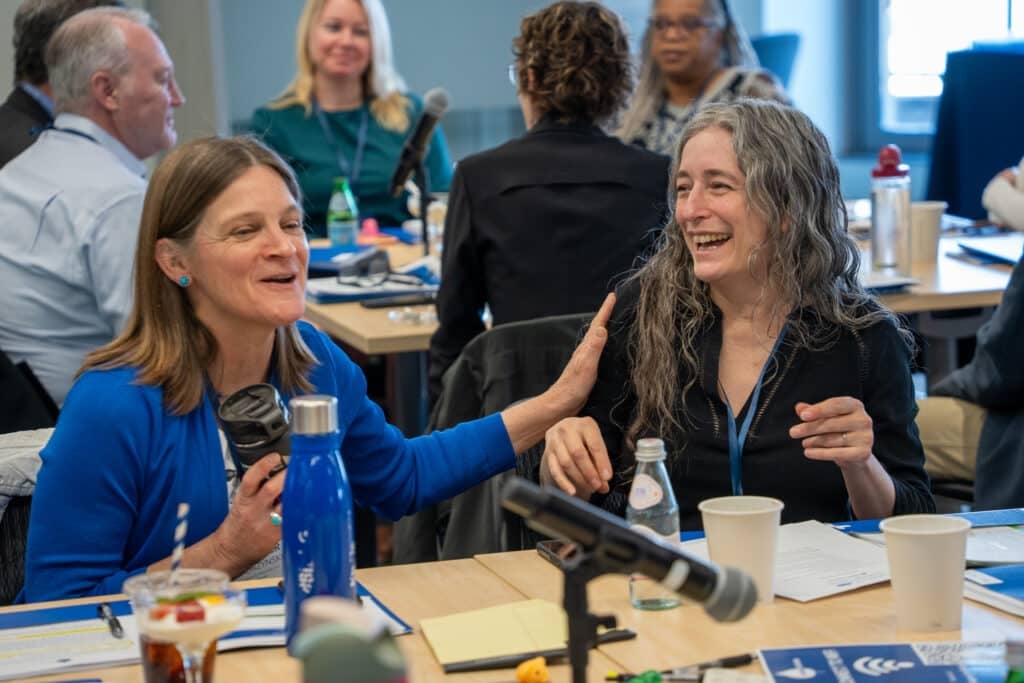
Hubs connect organizations and people within their regions, fostering learning across sectors. Hub leaders are eager for more opportunities to collaborate with peers in other areas—sharing successes and challenges, identifying promising practices, and advancing the model. The 2025 Hubs Summit, hosted by Aspen CSG, convened 39 leaders for two days of peer learning and exchange; future gatherings could expand on this convening.
The 2019 Aspen CSG report, which established the Hubs model, in conjunction with the Thrive Rural Framework, provides theories of change to guide both individual Hubs and the network as a whole. Building on this foundation, the next step is to resource new and emerging Hubs, strengthen established Hubs, and expand adoption of the model across rural America.
Case Study: The Power of Connection—Rural Development Hubs
When Hub leaders get together, the results are powerful!
Thrive Rural Framework building blocks:
Local: Organize an Action Infrastructure
Systems: Aligned Rural Fields and Actors
“I think the future of the field will require inviting others to join in the Hub movement. What are those on-ramps? How can those who’ve had to figure it out on their own show others how to do it and really build the field?”
Jerry Kenney, T.L.L. Temple Foundation, Texas

“There’s a life cycle to all of these things. It would be helpful to look at the life cycle of a Hub and what makes sense at different points along that cycle for resourcing and support.”
Nicole Manapol, International Economic Development Council, New York

“If we had a national rural development network where we could have more conversations with practitioners and funders in the room, there would be more movement for all of us in a forward direction.”
Kristina Cannon, Main Street Skowhegan, Maine
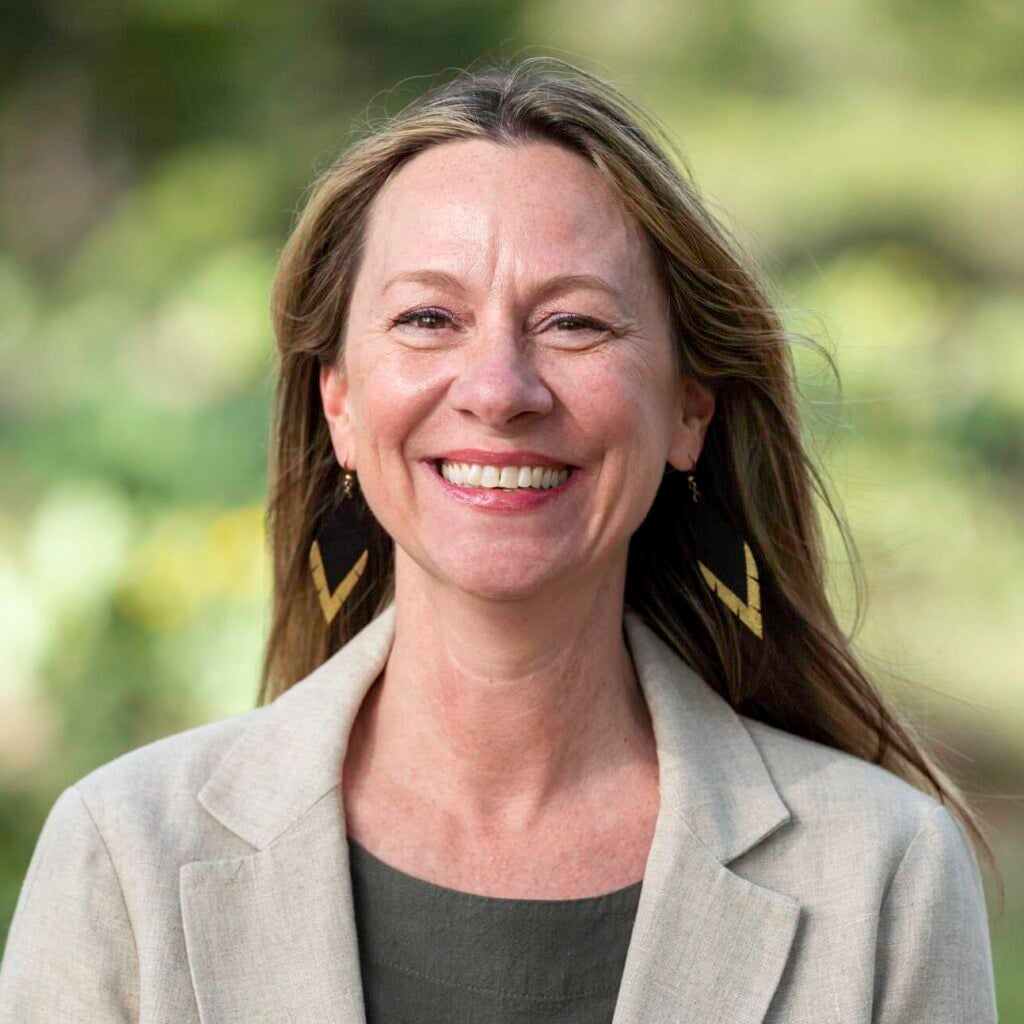
“If we learned more about the tactical budgets and capacity that support our peers’ success, we could expand our own opportunities. ”
Stacy Caldwell, Tahoe Truckee Community Foundation, California
“If we formalize hub collaborations, with each hub in a distinct but complementary role, then we could expand the reach and impact of our collective work.”
Jenna Rowell, Local First Arizona, Arizona
Recommendations
In 2025, Aspen CSG convened Hub leaders to discuss how to strengthen and build support for Hubs. They identified the following recommendations for government, philanthropy, and practitioners.
Cross-Cutting Recommendations
These recommendations apply to government, philanthropy, and practitioners at all levels.
- Listen to rural
- Don’t assume you know what rural communities need or want.
- Ask thoughtful questions and listen to the answers, even if they don’t align with your prior understanding.
- Remember how different rural communities and regions can be—do not assume that what applies to one community or region applies to another. This is especially applicable when working with Hubs that share geographies with Native nations.
- Grow relationships and trust
- Do the work to build authentic, impactful partnerships and collaborations across issue sectors with rural communities and Native nations.
- Make sure partnerships are grounded in mutual respect and careful listening, even in the face of conflict and discomfort.
- Build rural capacity and leadership
- Prioritize approaches that allow rural people and communities to build skills, resources, and infrastructure for future work.
- Support the next generation of emerging rural leaders.
- Take care of people
- Support organization staff, local leaders, and community members to do what needs to be done to make rural communities thrive.
- Provide training, support, and fair compensation to staff and community members, so they have the tools and energy to complete their work effectively.
- Support Hubs’ priorities
- Listen to what Hub leaders say they need.
- Support emerging peer networks and support systems for Hubs.
- Help Hubs answer pressing questions about their work (see “Advancing the Rural Development Hub Model” in The Power Of Connection: Rural Development Hubs In Action).
Government Recommendations
National Government
These recommendations apply to national government entities across the executive and legislative branches. Examples: Congress members and staffers, departments (e.g., Department of Agriculture, Department of Energy), and agencies (e.g., Economic Development Administration, Bureau of Indian Affairs).
- Stay connected to rural
- Let community needs drive funding opportunities—support on-the-ground and bottom-up approaches.
- Keep open lines of communication and engagement with communities
- Participate in rural events and convenings.
- Be strategic and collaborate
- Create a national rural development strategy that allows for place-based approaches and investments.
- Communicate how rural communities, our national economy, and our security are interconnected and depend on successful rural development.
- Expand the concept used for coal community rapid response: direct access to inter-agency sessions through liaisons and advocates.
- Establish public-private partnerships between government agencies, philanthropy, and the private sector.
- Work with Regional Development Hubs on regulatory reform.
- Redesign systems
- Be bold—do new things rather than adding another layer to previous work.
- Build a new funding system to replace competitive grants—start with impact on capacity and readiness and work from there.
- Streamline rural development funding systems (see the Brookings Institution “spaghetti graph”).
- Establish programs that provide multi-year, significant operating and capacity building funding, focusing on rural development outcomes rather than specific, limited projects.
- Fix barriers
- Honor contractual commitments; change should only be forward-looking.
- Do not require a match for Tribes, economically distressed areas, and areas of environmental concern.
- Move away from reimbursable grants, which are unworkable for many community-based organizations.
- Support robust third-party evaluation to capture lessons learned, best practices, and pitfalls.
- Recognize the importance of regional Rural Development Hubs
- Educate agency staff on working with Hubs.
- Consult Hubs and involve them in program design, not just roll-out and utilization.
- Require grantees to engage in collaboration and other key Hub work.
- Fund rural needs
- Rural communities are not just agriculture: distinguish rural development community funding from other priorities in the Farm Bill.
- Appropriate funding for service programs that provide essential capacity building for rural.
- Appropriate funding for comprehensive rural-focused grants that build capacity.
- Recognize and support anchor employers of all types in rural regions.
Recommendations for the US Department of Agriculture (USDA)
- Support navigators to ensure access to opportunities, technical assistance, and coordination.
- Create an office of small farms within USDA.
- Expand and reform capacity-building funding (e.g., Rural Community Development Initiative (RCDI), the proposed Rural Partners Program).
- Support state office infrastructure.
- Collaborate across state lines for efficiency.
- Coordinate with BIA to make sure Tribes have access to development loans.
Recommendations for the Department of the Interior and the Bureau of Indian Affairs (BIA)
- Be more flexible and responsive—less one size fits all.
- Remove unrealistic reporting and match requirements.
- Support navigators and cross-agency working groups to help Tribes access funding.
- Coordinate with USDA to make sure Tribes have access to development loans
- Invest in pilot programs to see what works.
- Revisit policy on the length of trust land leases (99 years does not provide intergenerational stability).
- Learn about and support Native nation building.
- Ground the work in the treaties and the trust obligation that the federal government has to federally recognized tribes.
State Government
These recommendations apply to state government entities across executive and legislative branches. Examples: state legislators and staffers, departments (e.g., Department of Health, Department of Labor), offices (e.g, Office of Rural Prosperity), and boards and commissions (e.g., Board of Education).
- Create and sustain structures to support rural
- Establish and/or support statewide offices of rural prosperity.
- Provide permanent funds from extractive industry severance taxes.
- Design state rural development strategies that center regionally-led, place-based approaches.
- Create carve-outs for rural communities in state funding based on percent-change metrics rather than overall volume.
- Ensure equitable distribution of federal funds among urban and rural communities based on capacity, readiness, and best practices.
- Build a strong staff that understands rural
- Hire adequate legislative and agency staff, including those from rural regions.
- Pay staff a living wage.
- Educate staff on rural and Indigenous issues.
- Address problems related to high turnover and lack of institutional memory.
- Engage with rural
- Encourage staff to engage with communities (visit, meet, attend events) to stay informed about what is happening on the ground.
- Publicize funding opportunities widely.
- Expand networks and contacts in communities across the state instead of always going to the same partners.
- Respect and work with Native nations
- Maintain strong Tribal government relationships and alliances.
- Partner and coordinate with Tribes on projects and funding.
- Take Tribal consultation seriously: educate state leaders on the process, and do it properly.
- Partner with Rural Development Hubs
- Learn about the social sector and its role as extension and connection.
- Fund and support Hubs and partner organizations.
- Support the development of Hubs, but avoid mandates relating to them—Communities and regions should drive Hubs.
- Use language specific to Rural Development Hubs in SOPs and plans (e.g., “we will work with Rural Development Hubs to…”).
- Create links between urban and rural
- Use local Comprehensive Economic Development Strategies (CEDS) and state, city, and county agencies to help understand urban/rural differences and interconnections.
- Create intentional collaborations between urban and rural communities within regions.
- Embrace the role of intermediary between communities and the federal government
- Advocate for rural issues and programs at the federal level.
- Fill gaps related to federal changes and cuts where possible.
- Be strategic, not just tactical.
- Use equitable, asset-based approaches to funding and rural development
- Do not require a match for Tribes, economically distressed areas, and areas of environmental concern.
- Provide grant funding up front, not through reimbursement.
- Fulfill payment obligations and timelines.
- Measure percentage change rather than volume numbers (see Measure Up: A Call to Action from Aspen CSG).
- Avoid competing with community groups for federal funding.
Local Government
These recommendations apply to local (city, town, and county) government entities across executive and legislative branches. Examples: elected leaders (e.g., mayors, councilmembers, county commissioners), administrators (e.g., town and city managers), and departments (e.g., emergency management, planning).
- Stay accessible
- Be curious—stay open to new ideas and don’t be afraid of conflict.
- Engage the community before and during decision-making.
- Promote system change and build engagement by involving as many people as possible in local master planning.
- Host welcoming community meetings and events: schedule them at times accessible for community members, provide opportunities for virtual viewing, have reliable audio/visual equipment, and provide childcare to support the attendance of parents/caregivers with young children.
- Build your own capacity
- Invest in leadership development for electeds and staff (e.g., adaptive leadership training).
- Train staff in meaningful, effective community engagement.
- Access technical support when needed.
- Encourage a new generation of leaders.
- Establish respectful working relationships with Tribal governments
- Honor tribal sovereignty.
- Collaborate with Tribal governments.
- Support Tribal housing and development of properties on trust land.
- Build strong partnerships
- Embrace being a node within the regional ecosystem, in deep relationship with others in the ecosystem (other local governments, Hubs, etc.).
- Get to know your Rural Development Hubs and keep them “on speed dial”.
- Send representatives to county meetings and gatherings hosted by other governments and organizations.
- Meet regularly with local partners.
- Ask partners to help you engage the community.
- Support Rural Development Hubs
- Learn about the Hub model.
- Support adoption of the Hub model and Hub-like approaches where appropriate.
- Support Hubs with resources (e.g., funding, property).
- Support important local work
- Fund local and regional ecosystem builders.
- Encourage community benefit agreements.
- Contract with local vendors whenever possible.
- Encourage local development (e.g., reduce parking requirements for downtown buildings).
- Stay practical
- Govern within your authority and limitations—focus on solutions.
- Pay attention to budget restraints and changing circumstances.
- Maintain consistent policies around local taxes.
- Keep a long view, beyond the current fiscal year or term.
Tribal Government
- Lead with sovereignty when dealing with all other governmental entities.
- Remember, there is power in more voices at the table.
- Leverage the power of inter-Tribal working groups.
- Facilitate conversations that identify common ground.
- Encourage Hubs and Hub-like approaches to holistic development in the region.
- Engage national, state, and local philanthropy to learn about the economies of Tribes.
Philanthropy Recommendations
National Philanthropy
These recommendations apply to philanthropic organizations with a national scope. Examples: independent foundations (e.g., Robert Wood Johnson Foundation), family foundations (e.g., Blandin Foundation), corporate foundations (e.g., Walmart Foundation), and public charities/donor-advised funds (e.g., Fidelity Charitable).
- Understand the landscape and your role in it
- Know the history behind the wealth that created your foundation; if wealth was extracted from rural, use it to support rural.
- Understand the foundation’s mission and program oscillations and their impact on communities and grantees; avoid doing harm with changes.
- Clearly define your goal (e.g., place-based philanthropy vs. scaling solutions).
- Seek funding parity between rural and urban communities.
- Play the long game
- Support long-term approaches and multi-generational strategies.
- Ask “how does this work affect the networks and infrastructure of the nation?”.
- Seek to understand and align with grantees’ long-term frameworks.
- Take risks, be creative, and use all the tools available
- Engage in impact investing and other investments beyond grants.
- Private foundations: give more than the required 5% payout.
- Align leadership, governance, and funding.
- Reframe modern portfolio theory and fiduciary responsibilities.
- Consider a significant collaborative effort to fund Rural Development Hubs at scale.
- Study the impact of funding with fewer restrictions: are the outcomes more transformational?
- Support and learn from rural communities
- Spend time in rural America.
- Engage deeply in places where you work.
- Hire folks from rural areas as program officers.
- Recognize that rural places do not want to become urban places.
- Recognize that communities contorting to fit funder perspectives is inefficient.
- Maintain strong communication loops around learning, trust, and accountability.
- Deepen understanding of Rural Development Hubs, how they work, and how they vary.
- Use your voice
- Advocate for rural community priorities in national spaces.
- Engage in storytelling to lift up rural work and positive rural narratives.
- Measure the impact of investments and publicize that impact to draw investment from corporate and other funders.
- Collaborate
- Collaborate across national philanthropy to reduce the burden on organizations serving on multiple overlapping “learning networks”.
- Utilize existing rural gatherings, networks, and organizations for expertise.
- Understand power dynamics and try to shift from traditional grantor/grantee relationships to more equitable partnerships.
- Embrace partnerships with regional rural funders.
- Invest in Rural Development Hubs
- Support intermediaries building community capacity.
- Invest in Hubs at regional levels, not just national intermediaries and technical assistance providers.
- Find ways to provide regional backbone or back office support.
- Use Hubs to re-grant funds closer to the ground.
- Support national rural development collaboration infrastructure, including regular large rural gatherings with unscheduled time for connection.
- Make multiyear unrestricted grants to Rural Development Hubs.
- Recognize the need for conscious complementarity to federal funding
- Provide a match where useful.
- Support organizations transitioning from federal funding.
State Philanthropy
These recommendations apply to philanthropic organizations with a state or multi-state scope. Examples: independent foundations (e.g., Northwest Area Foundation), family foundations (e.g., Patterson Family Foundation), corporate foundations (e.g., Land O’Lakes Foundation), and public charities/donor-advised funds (e.g., state-focused community foundations).
- Leverage your role
- Act as a convener for organizations across the state (e.g., convene rural and urban economic developers to share approaches and develop collaborations).
- Use your voice, power, and relationships to seed change in systems.
- Consider taking on a research and development role in your ecosystem.
- Organize rural philanthropy networks at the state and regional levels (e.g., Texas Rural Funders, Appalachia Funders Network, Delta Philanthropy Forum, Greater New Orleans Funders Network).
- Take action
- Try new approaches and learn.
- Don’t be afraid of funding something new and different.
- Be careful about too much introspection at the expense of action.
- Private foundations: disburse more than the required 5% payout.
- Design equitable and accessible funding and reporting systems
- Provide ongoing support with minimal administrative burden.
- Be careful of forcing communities to compete against each other for funding.
- Consider partnering with regional organizations like Rural Development Hubs to distribute funds to communities.
- Invest in smaller communities.
- Respect rural communities and people
- Offer compensation (e.g., honoraria) for time spent advising.
- Approach relationships with Hubs as a generational investment.
- Involve communities in planning and framework development.
- Build the capacity of rural communities
- Support leadership networks.
- Support intermediaries that work with communities to build capacity.
- Co-create investment opportunities in rural communities.
- Elevate grantee community voices
- Tell community stories (e.g., profiles, interviews, videos).
- Connect communities to donors (e.g., events, introductions).
Finding the Right Region: Aspen CSG defines a “region” as an area involving multiple jurisdictions (e.g., counties, states) where collaboration makes sense for geographic, financial, cultural, or other reasons. This definition is flexible, as appropriate regions vary widely across rural America—a region suited for collaboration in Montana may look very different from one in West Virginia. Defining and working across a region should be led by the people, organizations, and jurisdictions of that region— those who know it best.
Local Philanthropy
These recommendations apply to philanthropic organizations with a local scope. Examples: independent foundations (e.g., Minnesota Initiative Foundations), family foundations (e.g., Richard King Mellon Foundation), corporate foundations (e.g., local bank foundations), and public charities/donor-advised funds (e.g., local community foundations).
- Stay connected to your community
- Build relationships that are not only based on funding.
- Engage with rural areas—get out of your office and be in the community.
- Partner with Tribal governments.
- Hire young people for your staff and ask them to serve on your board.
- Be bold and proactive
- Actively engage in co-creating projects to leverage.
- Consider other investments beyond grants, including supporting capacity building/leadership development for nonprofit staff.
- Private foundations: give more than the required 5% payout.
- Incorporate trust-based philanthropy principles.
- Take more risk.
- Be a catalyst
- Make introductions and connections.
- Embrace your role as a bridge-builder for your rural region.
- Engage in catalytic grantmaking (e.g., leverage, matching funds).
- Don’t fund the thing (e.g., broadband, water, housing)—fund the ecosystem that does the thing.
- Move from transactional to transformational.
- Tell the story of your community.
- Create the philanthropic conditions for Rural Development Hubs to thrive
- Undertake regional funding ecosystem landscape analysis.
- Provide long-term support for Hub infrastructure.
- Invest in capacity building at the local level.
- Help grantees focus on the work
- Provide unrestricted funding whenever possible.
- Provide technical expertise to grantees to improve systems and service delivery.
- Communicate clearly about what funding is available and in what form.
- Simplify application processes and share feedback with those who were declined for funding.
- Keep learning
- Use a research and development model—learn from failure.
- Learn from peers with successful models and approaches.
Power and Scarcity: In underinvested regions, the scarce resources are often controlled by entrenched power structures. Scarcity can also fuel competition among communities and organizations, sometimes leading to gatekeeping by larger entities and blocking recognition of real opportunities. Building a collaborative Hub in this environment can be difficult, as new organizations or approaches may be seen as threats to the existing order. Emergent Hubs can navigate these dynamics with patience and care—building trust, grounding themselves in community, emphasizing mutual benefit and transformative impact, and working from an abundance rather than a scarcity mindset.
Rural Priority: Civic engagement and leadership
Hubs have identified a need for funding to strengthen civic engagement and leadership. To support this work, philanthropy can:
- Invest in civic education across generations.
- Support rural leadership networks and programs (e.g., a fellowship program for municipal and county leaders on regional wealth building, cohorts for next-generation leaders).
- Fund leadership training in collaboration, conflict resolution, and complexity.
- Back community-driven engagement efforts.
Practitioners Recommendations
These recommendations apply to practitioners in the field of rural development, including national NGOs, Rural Development Hubs, and their local partner organizations.
- Deepen collaboration
- Keep the region at the center of your work and hold yourself accountable to the community.
- Convene coalitions in response to landscape changes (e.g., federal funding cuts, natural disasters, major employer closures).
- Attend regional rural-focused gatherings in other parts of the country and build relationships with peers.
- Join efforts with other organizations, including other Hubs.
- Find creative ways to share resources and create efficiencies.
- Don’t be extractive: always remember that your community and region are more important than your organization.
- Strengthen your organization and organizational structures
- Align mission and business plans.
- Develop accounting systems that allow for full accounting of program costs.
- Measure how much risk your Hub can manage (e.g., know your financial capacity to front funds you only get back on a reimbursement basis).
- Invest in staff and their development.
- Staff and grow your teams with people from the places you serve.
- Train staff in an asset-based approach to the work and communication about the work.
- Ground yourself in your purpose and mission—be careful about chasing funding, maintain power and boundaries, and teach these skills to your staff.
- Speak up
- Push back on harmful narratives and actions with positive frames of impact and opportunity.
- Speak in plain, direct language that resonates with your region—know your audience.
- Communicate needs: tell local and state philanthropy what you need them to be or do.
- Encourage funders to take risks (e.g., lending on Tribal trust lands).
- Communicate the value of Hubs (and the value of having a national model and network).
- Politely call out bad behavior by funders, partners, and the public sector.
- Advocate for yourself—walk away or say no when needed.
- Support and learn from other Hubs
- Help communities take the next step toward Hub development.
- Participate in field-building.
- Take time to travel to other regions to learn from other Hubs.
List of TRALE Participants | Affiliations as of March 2025
Aubrey Abbott Patterson, Hutchinson Community Foundation, Kansas
Ebonie Alexander, Black Family Land Trust, Inc, Virginia
Leona Antoine, NACDC Financial Services, Inc., Montana
Roque Barros, Imperial Valley Wellness Foundation, California
Alissa Benoist, Four Bands Community Fund, South Dakota
Brandy Bynum Dawson, MDC, North Carolina
Stacy Caldwell, Tahoe Truckee Community Foundation, California
Kristina Cannon, Main Street Skowhegan, Maine
Patty Cantrell, New Growth, Missouri
Ernestor De La Rosa, ITC Great Plains, Kansas
Julianna Dodson, Hannah Grimes Center, Inc., New Hampshire
Nancy Fasching, Southwest Initiative Foundation, Minnesota
Bonnie Gettys, Barry Community Foundation, Michigan
Colby Hall, Shaping Our Appalachian Region, Kentucky
Peter Hille, Mountain Association, Kentucky
Cheryal Hills, Region Five Development Commission, Minnesota
Rebecca Huenick, May Tree LLC, Vermont
Janice Ikeda, Vibrant Hawaiʻi, Hawai’i
Jerry Kenney, T.L.L. Temple Foundation, Texas
Heidi Khokhar, Rural Development Initiatives, Oregon
Winter Kinne, Community Foundation of the Ozarks, Missouri
Dr. Tim Lampkin, Higher Purpose Hub, Mississippi
Tito Llantada, Trust for Civic Life, Colorado
Felecia Lucky, Black Belt Community Foundation, Alabama
Nicole Manapol, International Economic Development Council, New York
Robin Meneguzzo, Keweenaw Community Foundation, Michigan
Jason Neises, Community Foundation of Greater Dubuque, Iowa
Rob Riley, Northern Forest Center, New Hampshire
Jenna Rowell, Local First Arizona, Arizona
Tiffany Sanderson, Lake Area Technical College, South Dakota
Olivia Sloan, Anchorum Health Foundation, New Mexico
Jennifer Sporzynski, Coastal Enterprises Inc., Maine
Jessica Stago, Change Labs, Navajo Nation/Arizona
Jennie Stephens, Center for Heirs Property Preservation, South Carolina
Connie Stewart, Cal Poly Humboldt, California
Stephanie Swepson Twitty, Eagle Market Streets Development Corporation, North Carolina
Stephanie Tyree, West Virginia Community Development Hub, West Virginia
Maria Urias, Sustainable Forestry and African-American Land Retention Network (SFLR), Tennessee
Jeff Yost, Nebraska Community Foundation, Nebraska
Partners who didn’t attend the convening that informed this report, but shared valuable insights in follow-up discussions:
Justin Archer Burch, Delta Compass-WCEA, Mississippi
Dave Castillo, Native Community Capital, California
Nils Christoffersen, Wallowa Resources, Oregon
Ta Enos, PA Wilds Center, Pennsylvania
Angie Main, NACDC Financial Services, Montana
Ines Polonius, Communities Unlimited, Arkansas
Jacqueline Shirley, RCAC, New Mexico
Erik Stegman, Native Americans In Philanthropy, DC
Support for this report was provided by the Robert Wood Johnson Foundation. The views expressed here do not necessarily reflect the views of the Foundation.
Aspen CSG’s consultant, Rebecca Huenick, led the writing process for this report. We are grateful for her contributions.
Related Resources
Rural Development Hubs
A national model identified by Aspen Institute Community Strategies Group.
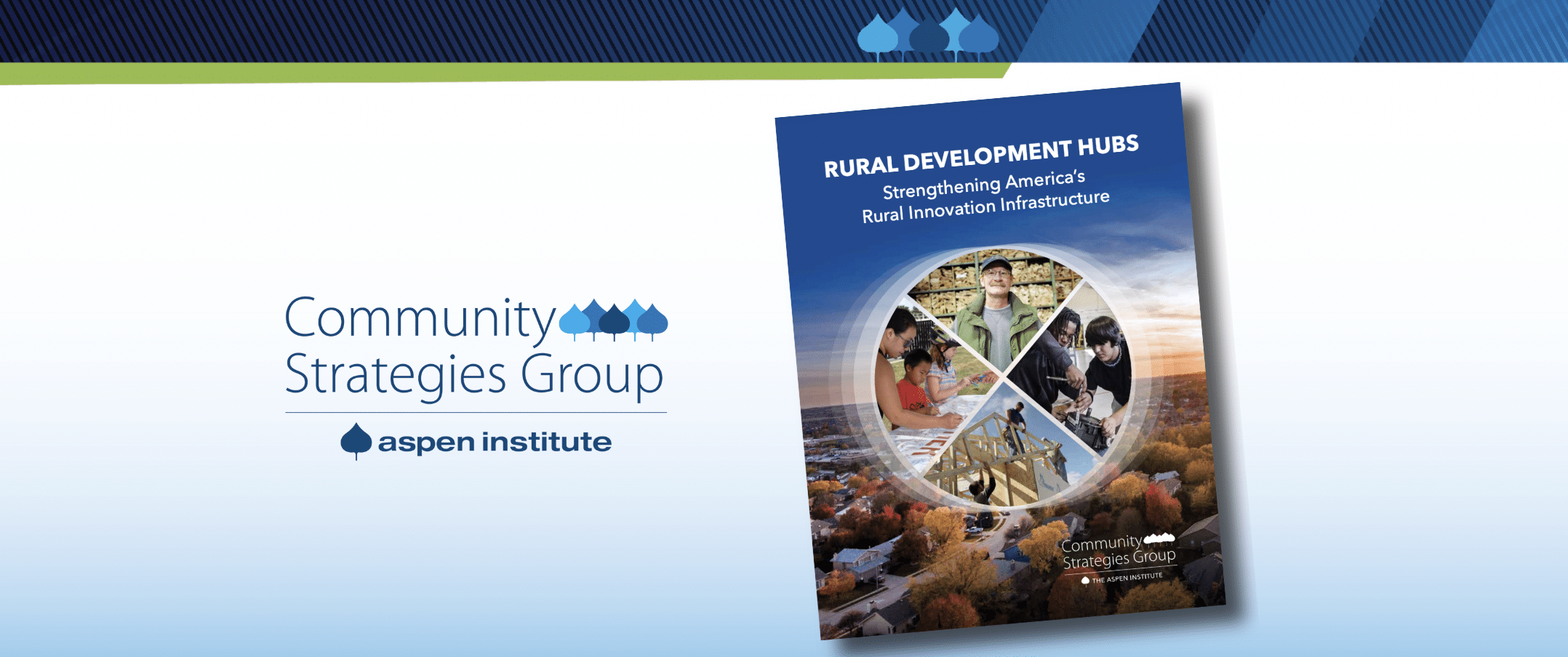
Rural Development Hubs: Strengthening America’s Rural Innovation Infrastructure
Rural Development Hubs are a specific set of intermediaries that are doing development differently in rural America. They are main players advancing an asset-based, wealth-building, approach to rural community and economic development.
WealthWorks: A Powerful Tool for Thriving Rural Places
WealthWorks is an approach to doing economic development differently that inspired and continues to inform the Thrive Rural Framework. Learn more about the WealthWorks approach.
From Competition to Cooperation: Rural Wealth Creation
Insights from rural practitioners who are advancing equitable prosperity and economic development in a way that embraces and strengthens the unique assets of rural regions.
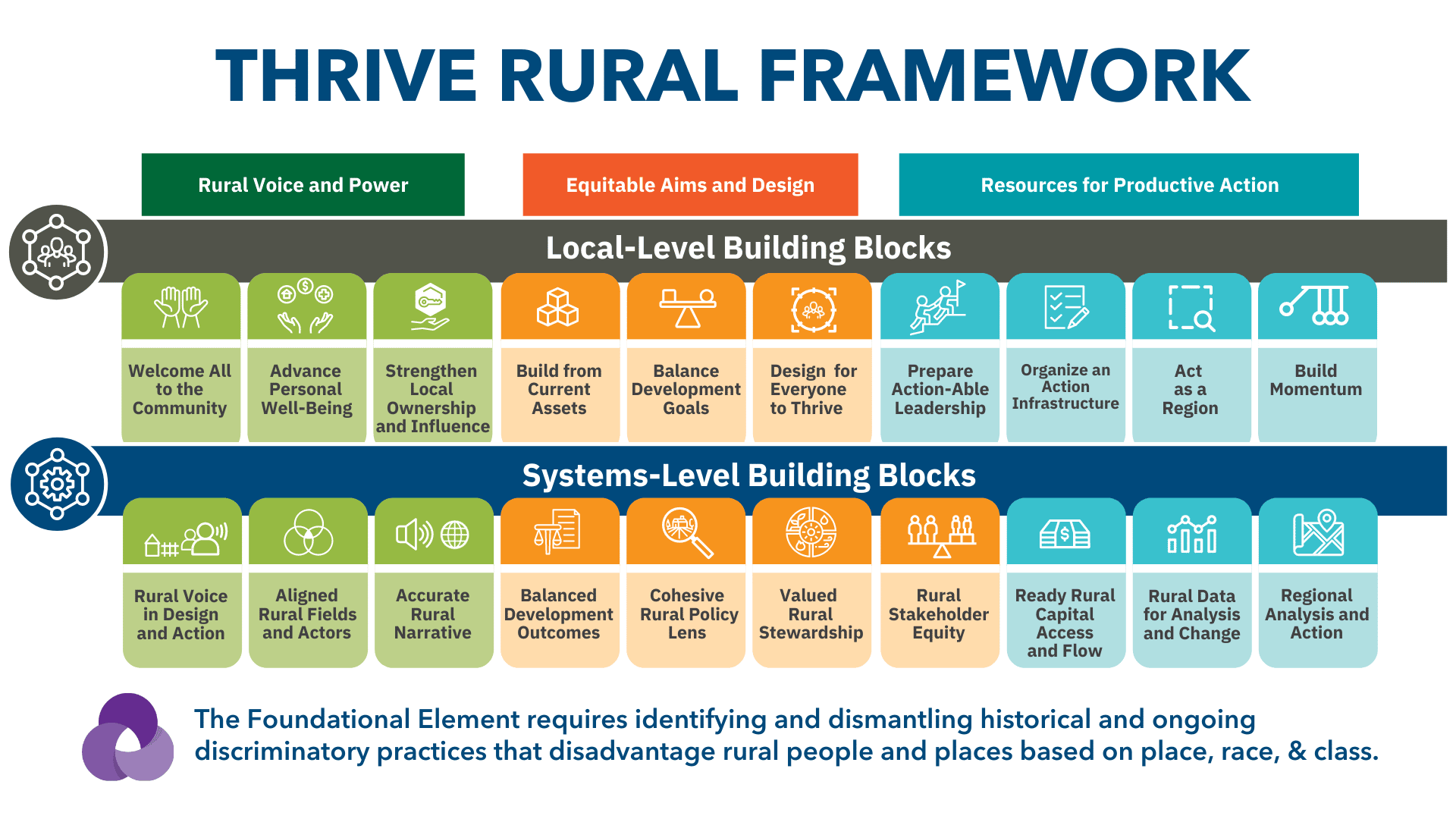
Thrive Rural Framework: Building Blocks
To spark new ways of thinking, the Thrive Rural Framework is designed to be looked at in many ways. At…