View this Publication

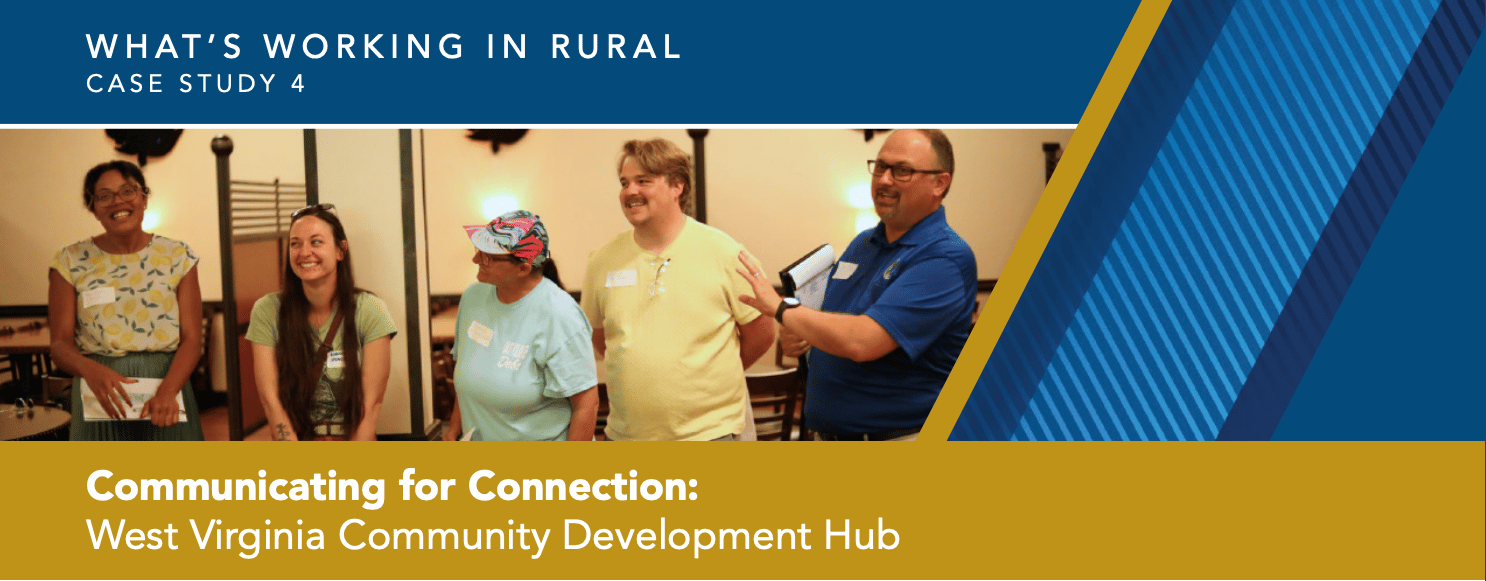
For the fourth case study in our What’s Working in Rural series, we examine how rural development practitioners can move beyond neutrality and still communicate effectively with community members from across the political spectrum.
Our case study is on The West Virginia Community Development Hub (The Hub), which supports West Virginians with the tools and training they need to lead and spark positive change in their hometowns and across the state.
As a facilitator and convener, The Hub has long seen itself as a neutral party, and its communications have reflected that sense of neutrality. In recent years, however, increasing political polarization and awareness of the problems with neutrality in the face of inequity spurred the organization’s leadership team into action.
The Hub worked to clearly articulate organizational values to create connection rather than division and alienation along political lines. This has been challenging work, and the organization’s communications staff have moved carefully and made a strong effort to learn from the process.
Their work has identified five key elements of communicating to connect:
- Articulate the organization’s values clearly.
- Find the right connecting language to identify the potential flashpoints.
- Choose your words carefully, but don’t mince them.
- Tell stories about specific people and places.
- Ground communication in action.
Download the case study for eight tips for implementing this practice in your organization.
Related Resources
Rural Democracy Initiative’s The Winning Jobs Narrative Project
The Winning Jobs Narrative creates a narrative architecture for talking about jobs, work, and the economy in ways that strengthen our connections with working people across race, geography, and issues.

Accurate Rural Narrative
Learn how accurate rural narratives shape public understanding, policy, and investment through research, practical guidance, and real-world examples.

Build Momentum
Communities and regions, no matter their starting points, produce and celebrate the small wins and steady progress that fuel hope and persistence.

Welcome All to the Community
Each person is welcomed to the community, feels connected, and is able to exercise and influence power in decision-making.

Organize an Action Infrastructure
Communities have the local and regional institutions, policies, systems, data, information, media, and resources needed to establish, align and achieve priorities that increase both well-being and equity.
Aspen CSG’s consultant Rebecca Huenink led the writing process for our What’s Working in Rural series. We are grateful for her contributions.