Charting a New Economic Future: Building a Public Constituency for Workforce Issues

View this Publication

Building a Public Constituency for Workforce Issues

This report explores the urgent need for policymakers to involve the public in discussions about the economy and the labor market. It also suggests ways policymakers can increase public awareness of these issues. The document highlights a gap between public and policy leaders’ understanding of workforce issues, citing a 1991 study by the Public Agenda Foundation. For instance, while leaders prioritize productivity, the public focuses on job availability. The document argues that building a public constituency is crucial for sustainable economic change, as changes like adopting new work structures or providing training cannot be mandated without public consent.The authors propose a four-stage framework for building public consensus:

  1. Awareness: Helping the public recognize that there’s a problem with the future economy (e.g., declaring a crisis, dramatizing events, personalizing issues, using media).
  2. Definition: Helping the public understand what the issue means in their lives and in a broader economic context (e.g., eliminating jargon, being consistent, involving affected people, listening, using compelling visuals).
  3. Attitude: Fostering an emotional commitment to the issue (e.g., addressing negative perceptions, accentuating positives, recasting “either/or” issues as “both/and,” finding common values).
  4. Behavior: Motivating the public to take action (e.g., acknowledging complexity, providing opportunities for public input, creating behavior checklists, offering easy access to information for concrete actions).

The document emphasizes that policymaking should start by assessing the public’s current level of awareness, attitude, and commitment, rather than assuming their understanding. It suggests using surveys to measure awareness and focus groups for defining and understanding attitudes. Finally, it provides a list of polling organizations and publications as resources for policymakers.


Aspen Institute Community Strategies Group
Latest From Aspen CSG
Blog
Green landscape with icons and designs over it
Building Capacity in Rural & Indigenous Communities

Insights and learnings from rural practitioners on how organizational capacity and technical assistance can be carefully and intentionally strengthened to grow economies, health, and livelihoods for each and every person in their regions.

Blog
Volunteer places a 'Vote Here' sign outside a rural community center before polls open.
A Reminder To Reporters: If You’ve Seen One Rural Place … You’ve Seen One Rural Place

By shaping accurate narratives, we can drive fair and just investments and policies that honor the people and places at the heart of rural and Indigenous communities.

Tool
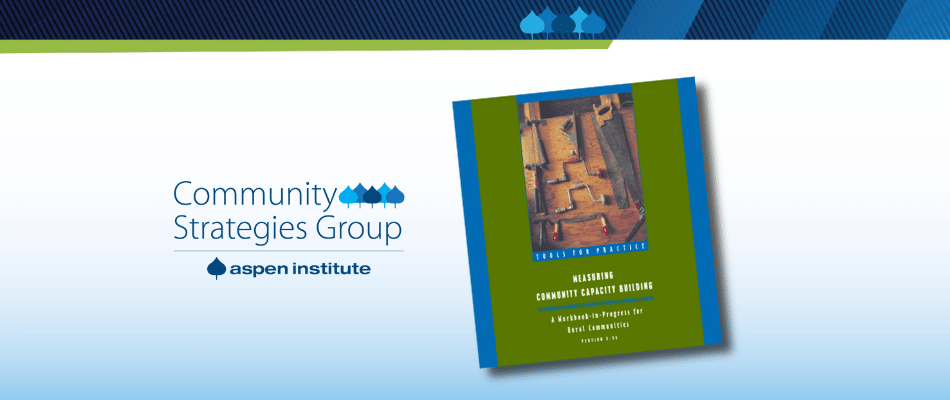
Measuring community capacity building book cover
Measuring Community Capacity Building Workbook

This is a workbook focuses on improving the ability of individuals, organizations, businesses, and government in their community to come together, learn, make well-reasoned decisions about the community’s present and future, and work together to carry out those decisions.

Blog
Ten Books for Rethinking Rural and Indigenous Development

Stories shape how we understand people and places. This list highlights narratives and research on the systemic forces affecting rural and Indigenous communities.

Blog
How Rural Development Hubs Can Strengthen Rural Health Transformation Program Implementation

Rural Development Hub leaders say new funding like RHTP works best when regions interpret it against existing priorities, coordinate it through existing partnerships, and adapt it to local context — rather than treating it as a distinct program.

Blog
Ten Podcasts Focused on Rural Community and Economic Development

Check out our roundup of podcasts highlighting important issues about and to rural communities and Native nations.